

Recent articles:
See the Table of Contents for a list of all published articles, grouped by stock.
Hidden Gems Investing has reached over 9,000 free subscribers and over 300 paid members in the 24 months since the newsletter was launched. Thank you. Most of our reports require well over 100 hours of work and thousands of dollars in research expenses. A subscription saves you enormous time and cost and protects you from future price rises. Join our members by upgrading below, or go here to learn about what you can expect as a paid subscriber:
Liberty Capital / Formerly GCI Liberty (GLIBA)
More background: Special Report, Acquisition of Quintillion, LILAK U-turn
Liberty Capital had strong results on November 5, sending the stock up 14% over two days when the S&P fell 4%.
Business:
Revenues +5% to $149mm, driven by "service upgrades with existing healthcare and education customers".
Gross margins increased 30bps to 78.5% despite having additional costs from Quintillion being restored. This is a tell-tale sign that growth was driven by healthcare and school contracts, which tend to be high margin.
Consumer:
Revenues +3% to $118mm, driven by Data revenues +2% and Wireless +4%. The Data business was boosted by a small acquisition that increased broadband subs by 5,400. Excluding that subs declined 900 q/q or 2.2% y/y to 154,500.
Gross margins declined 20bps to 72.0%.
Group adj OIBDA +10% to $101mm.
The growth in business revenues was particularly important because the Universal Service Fund fiscal year runs from July to June, meaning that Q3 was the first quarter of the 2026/27 fiscal year. The fact that business revenues grew 5% (data revenues grew 6%) is a positive leading indicator for the next three quarters.
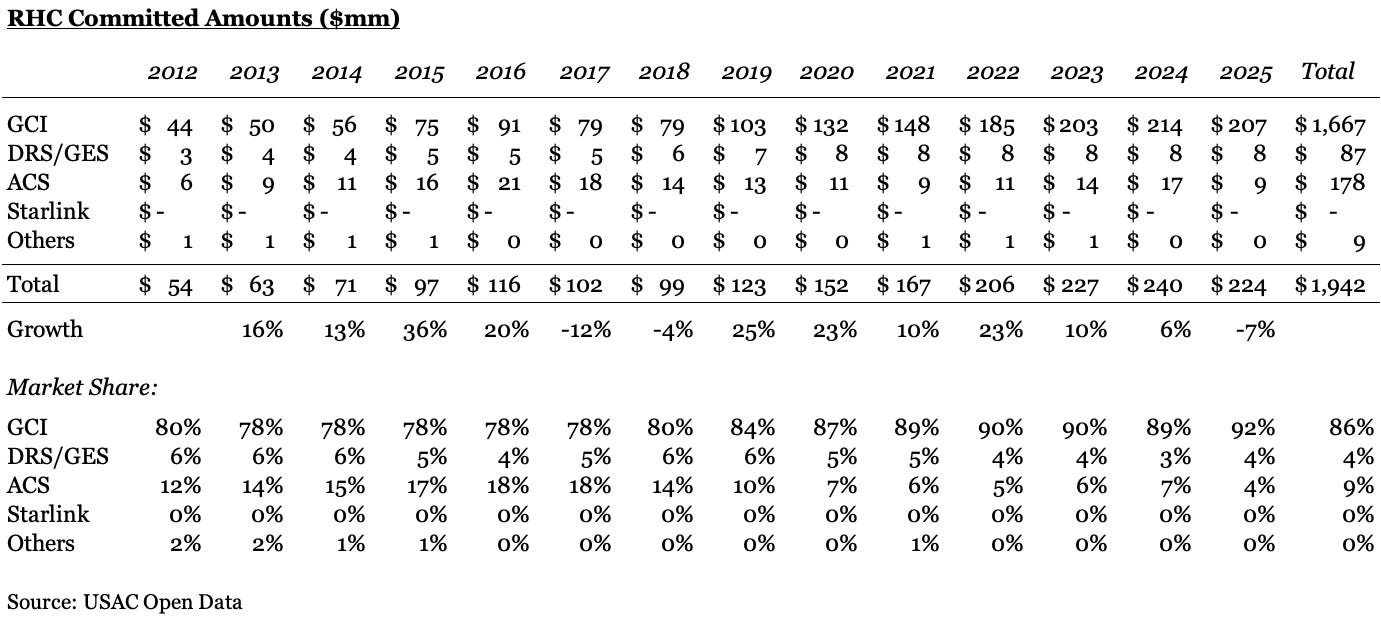
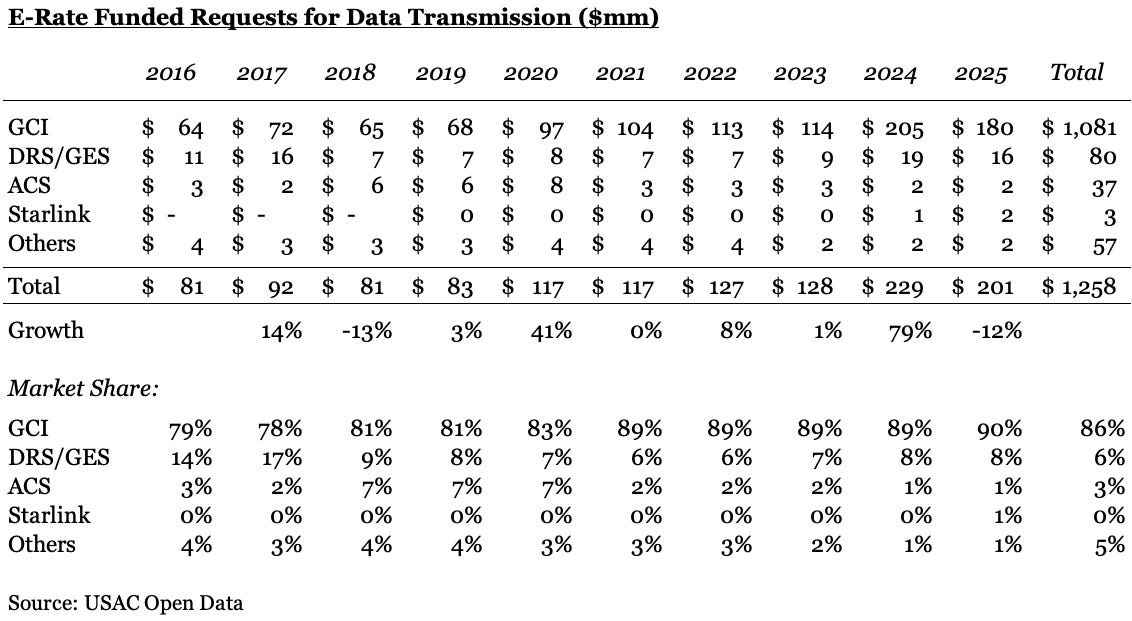
In the Special Report, I argued, and continue to believe, that investors are overly focused on the consumer business and the threat of Starlink. In fact, GCI generates most of its profits from government contracts for hospitals, clinics, and schools. These are funded by the Universal Service Fund through Rural Healthcare (‘RHC’) and E-Rate subsidies.
The market for these contracts has grown by low double-digit rates over time, and GCI’s market share has increased.
GCI’s fiber is the gold standard solution, and every person in the industry I talked to said that Starlink was not a threat for hospital contracts because those are life-and-death situations. A lot of healthcare in Alaska is administered over telehealth, where low latency, strong upload speeds, and reliability are critical.
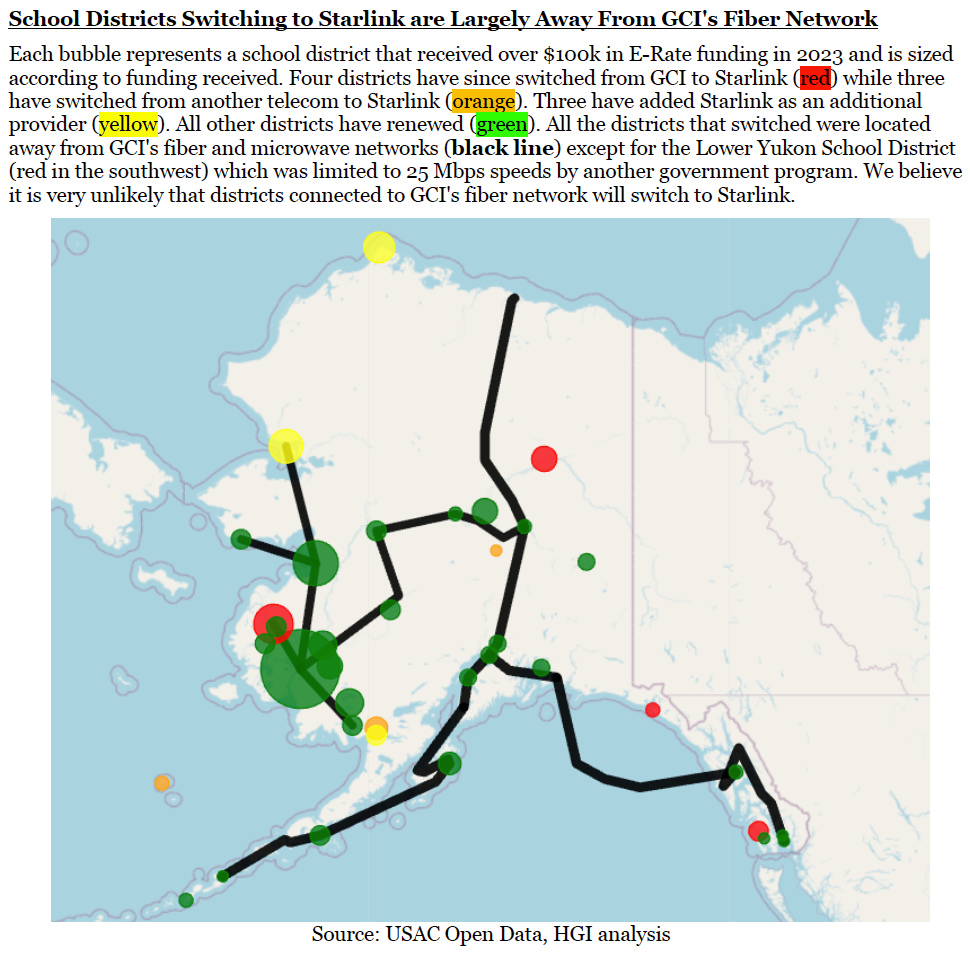
On the other hand, a few school districts have switched to Starlink because of the lower costs, but nearly all of those districts were in areas not connected to GCI’s fiber network.
The chart below lists all the major school districts in Alaska, with the size of each bubble representing the funding awarded to the district. Red dots represent districts that have switched to Starlink from GCI, whilst orange dots are districts that have switched from another provider to Starlink. As you can see, nearly all of those dots are away from the black line, which represents GCI’s fiber network. Those districts were either already on satellite or microwave rather than fiber.
For the districts that are on GCI’s fiber network, nearly all have renewed (green). GCI’s solution is the gold standard, and because schools are typically subsidized by about 90%, they have limited incentive to switch to cut costs.
If you’re interested in more detail, see the special report below and scroll to the section titled “The Threat From Starlink”.

There may be additional opportunities for GCI’s fiber business.
On the earnings call, CEO Ron Duncan said that an Alaska gas pipeline may be approved and that "we are increasingly optimistic that the project could ultimately move forward" and "some related opportunities may arise out of that."
My understanding is that these oil and gas projects take place around the North Slope in the Arctic Circle, and the oil and gas businesses would use GCI’s fiber to provide connectivity.
This should be further boosted by the integration of Quintillion, which is now expected by the middle of next year. Quintillion was the only other major fiber network in Alaska, and when combined with GCI, forms a ring around the state and provides redundancy.
Management confirmed on the earnings call they expect Quintillion to add $50mm to EBITDA. That should bring total Liberty Capital EBITDA from its current run-rate of around $390mm to $440mm, putting the stock on 4.4x EV/EBITDA. Charter and Comcast trade at about 5.0x.
The stock also looks cheap on an unlevered FCF basis. Assuming capex falls to 18% of sales over the next couple of years as management have guided to, I calculate FCF to be: $440mm EBITDA - $20mm SBC - $190mm capex - no tax because of tax shields = $230mm. That puts the stock on 8.7x EV/FCF vs Charter and Comcast on 9.2-9.8x.
Management initiated a new $100mm buyback authorization this quarter, on top of the $60mm per year dividend that was previously announced. I continue to prefer that they allocate capital towards acquisitions outside of Alaska and outside the traditional telecom space, thereby utilizing the company’s over $1bn of tax shields and underleverage to build an advantaged serial acquirer. However, the buyback and dividend combined provide up to a 15% annual return to shareholders while we wait.
XPEL
More background: Special Report, Manufacturing Build-Out, Growth Runway With OEMs & Color PPF
XPEL reported Q3 results on November 4:
Revenues = $137.8mm, +9.9%
US +7.0% / China +52.4% / Canada +17.9% / Europe -2.1%
PPF +15.7% / window film +11.8% / installation +4.5%
Gross profits = $61.5mm, +17.3%, 44.6% margin,
Gross margins increased 280bps y/y.
Gross margins increased despite input cost inflation from higher oil prices. However, cost pressures ended up being not as severe as management expected, and so they only took pricing increases of 1% or less in aggregate.
EBIT = $21.1mm, +25.8%, 15.3% margin
EBIT margins increased 190bps y/y despite G&A as a % of sales increasing 100bps to 18.5% of sales. That was partly because of startup manufacturing costs in Texas of $0.70mm or 51bps.
Q4 guidance is for revenues to be $125-$127mm, or +2.2% to +3.9%.
In my view, the quarter itself was stronger than I expected, particularly on margin expansion, but obviously the Q4 revenue guidance is disappointing. The stock declined 16% across the week, which I think is a huge overreaction.
I think investors underappreciate how difficult the market is right now. In the US, publicly traded dealers have reported new car sales down low to mid-single digits for several quarters, while XPEL has been delivering US growth in the high single digits.
XPEL also face headwinds in the US from FTC enforcement on dealers to provide transparent pricing. That can require PPF to be more clearly disclosed as an add-on rather than a compulsory item and has impacted a large number of dealers. CarMax, for example, reported in its Q2 and Q3 results that FTC enforcement was impacting dealers broadly while benefiting CarMax because of its transparent pricing. I don’t view this as a permanent issue and see it as something that will be worked through in the coming quarters.
In China, the new car market is down about 20% y/y, with companies like BMW reporting Q3 deliveries of -25%. XPEL’s biggest competitor, Eastman Chemical, reported that its performance film sales in Q3 were “down about 20% in sales.”
Given the cyclical challenges, I would not extrapolate the 2% to 4% growth in Q4 as permanent. In fact, management on the call said they see “ample ways to accomplish” the low double-digit growth the company achieved in Q1 through Q3. Investors overreacted to Q1 results when the company guided to a slowdown in Q2, and I think something similar has happened here.
In fact, I would argue that XPEL’s structural growth rate may be increasing.
Paid subscribers get:
XPEL’s OEM growth pipeline that is 2x its entire history
30 page Special Report on XPEL, based on interviews with 54 sources
The Idea Book with my top 20 small cap ideas, and a list of Special Reports you can find here:

Join the 300+ subscribers who have upgraded to paid to read the writeup: