

Seaport Entertainment trades at a market cap of $300mm despite holding $87mm of net cash and properties near Wall Street that have had $1.2bn invested in them. The company has been burning cash since it was spun off and many investors put it in the ‘too hard’ bucket.
I think that is about to change.
This article discusses:
Four catalysts that begin from August
Why property-level EBITDA is about to turn positive for the first time
Profitability by segment after programmed leases and spaces begin
Why earnings power is likely substantially higher than management’s own numbers suggest

Seaport Entertainment spun out of Howard Hughes in July 2024 and owns a complex portfolio of properties, primarily in Manhattan just 10 mins walk from Wall St. The company is put in the ‘too hard’ bucket by investors but has a market cap of $300mm vs $87mm of net cash and properties Howard Hughes spent $1.2bn on. Execution by new management post-spin has been strong and the company is about to turn Operating EBITDA positive.
For more background read the Special Report, based on interviews with 21 sources and multiple site visits.
Underlying Earnings Power Today
Seaport’s financials are incredibly complex, but I estimate run-rate EBITDA at the property-level has now improved to a $-7.3mm loss, and will be positive $5.9mm once already announced leases and programming begin.
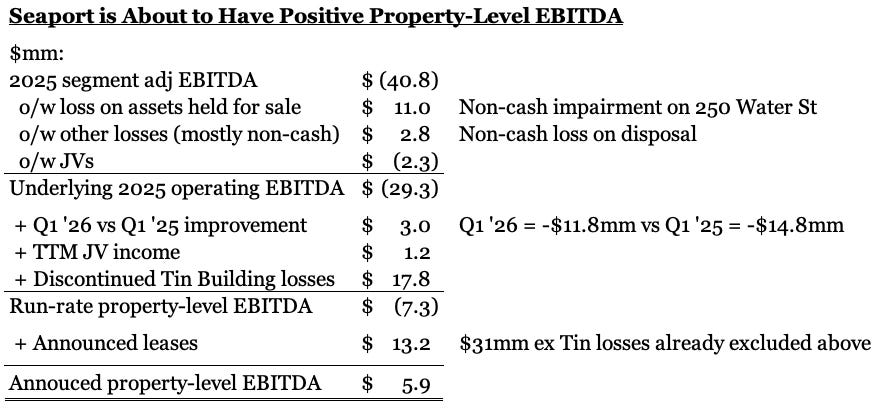
Given the summer tends to be more profitable for the company, I expect Seaport will generate positive property-level EBITDA for the first time in either Q2 or Q3, which may allow investors to start thinking beyond the company’s previous losses and towards what future profitability will look like.
Seaport reports three segments:
Hospitality - Restaurants and bars at the Seaport
Entertainment - Seaport rooftop and major events, Vegas baseball team
Landlord - Leases at the Seaport
By breaking out the financials by segment, we can see that only the Hospitality segment is now loss-making:
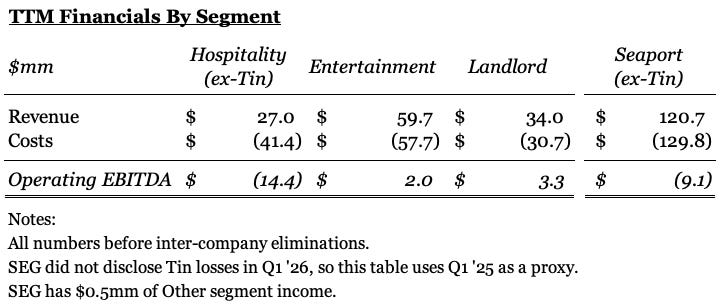
Note that I have excluded the now shut Tin Building from Hospitality to show what earnings are today. The segment generated $49.3mm in revenues and $-32.2mm in EBITDA over the last 12 months, while the company’s presentations show the Tin lost $17.8mm in EBITDA in 2025. I have estimated what that implies for revenues and costs using ratios from the Tin’s filings in 2024.
All of these numbers are before inter-company eliminations. The Hospitality segment leases a significant amount of space from the Landlord business and those costs get excluded after intercompany eliminations.
However, I think looking at the P&L before that is a better way to understand each segment’s standalone economics, as the space leased by Hospitality has a real opportunity cost as it could have been leased to external parties at market rates.
Programmed Profitability
In its Q1 presentation, Seaport disclosed that incremental EBITDA from announced programming is expected to total $31mm.
Given that we know the Tin lost $17.8mm in 2025, that implies management expects the additional leases and programmed space to generate $13.2mm in EBITDA.
By allocating each programmed space to a segment, we can see that the company is expected to generate $4.1mm in EBITDA once the leases begin. Adding the $1.2mm in trailing 12 month earnings from JVs and $0.5mm in Other segment profits gets to the announced property-level EBITDA of $5.9mm I estimated above.
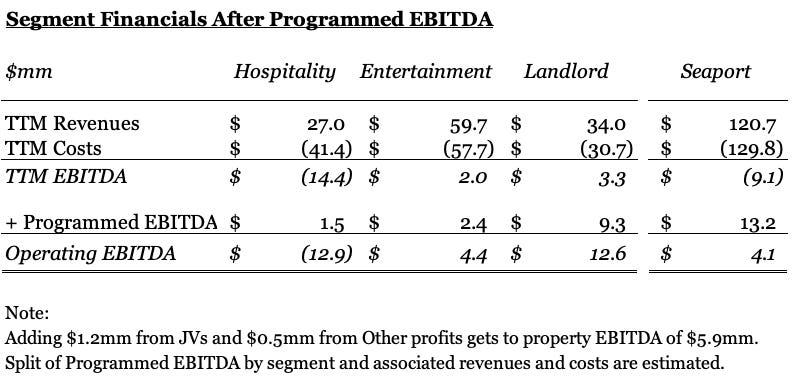
There are two key conclusions I draw from this.
The Landlord business is about to become a solidly profitable business with a projected EBITDA margin in the high 20s/low 30s. But the implied lease rates sit well below comparable space nearby, and I think will grow significantly.
Very little of the new programming sits in Hospitality, so on my numbers the segment stays loss-making before inter-company rent. That is about to change as new tenants drive more visitors to the area.
The investors who figure out Seaport's real earnings power won't get there by just adding programmed EBITDA to today's numbers. And the Entertainment segment, which barely registers in these numbers, I believe will also be a key catalyst for the stock.
Finally, a constraint has tied management’s hands since the spin-off. That ends in August, and at that point I see four upcoming catalysts for the stock.